 English
 Chinese (Simplified)
 Khmer
Khmer Lao
Lao Thai
Thai Vietnamese
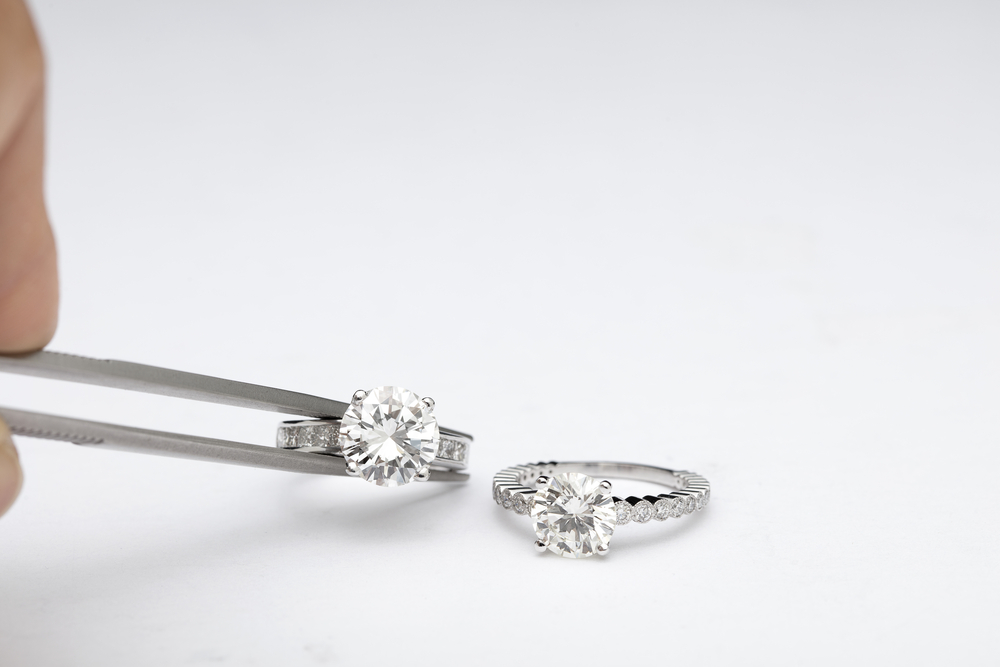
What is the difference between VS2 vs VS1 diamond clarity? In this article, we look at both of these clarity grades in detail: their appearance, their price, and their investment value. You’ll also learn when you should purchase one or the other, depending on the type of diamond you’re buying.
Mục lục
First, the Four Cs
If you’re reading this article, you probably already know about The Four Cs of diamond quality – cut, colour, clarity and carat weight. These 4 important factors determine the price of a diamond. If you aren’t familiar with them, we recommend you read this article first.
What does clarity mean?
The ‘clearer’ your diamond is, the fewer inclusions it has.
So what exactly are inclusions?
Inclusions are small imperfections or marks within the diamond’s crystal. These tiny markings appeared millions of years ago, when the diamond formed under huge pressure under the Earth’s crust. They are therefore entirely natural. Inclusions can manifest as black dots, bubbles or fissures within the diamond.
Clarity always affects the price
A diamond with many visible inclusions is considered to have a low clarity grade. The lower the clarity grade, the lower the diamond’s price. On the other hand, a diamond with only a few inclusions that are so small they cannot be seen with the naked eye has a high clarity grade. This, in turn, will raise its price.
The clarity scale, from good to poor
There are eight diamond clarity grades. They range from diamonds with inclusions that are clearly noticeable, to diamonds that are seemingly flawless even under magnification. They’re called:
FL – Flawless
IF – Internally flawless
VVS1 – Very, Very slightly included 1
VVS2 – Very, Very slightly included 2
VS1 – Very slightly included 1
VS2 – Very slightly included 2
SI1 – Slightly included 1
SI2 – Slightly included 2
I1 – Included
Why VS clarity grade is a good choice
VS diamonds offer high quality for a reasonable budget. A gemmological expert would have to use a 10x magnifying loupe, and quite a bit of time and effort, to see the inclusions inside it. In fact, gemmologists characterise VS inclusions as “minor”. At the same time, VS diamonds are much more affordable than VVS and IF diamonds. This means that VS diamonds represent excellent value for money.
Do VS diamonds have investment value?
Yes, VS diamond will appreciate in value over time. This is because firstly, a VS diamond will display beautiful light play and sparkle. Secondly, it won’t have any structural issues, such as chips or cracks. And finally, while a VS diamond isn’t flawless, it is still quite a rare quality grade. All these factors make it a worthwhile investment.
What do the numbers 1 and 2 mean – VS1 and VS2?
A VS1 diamond has slightly fewer and smaller inclusions than a VS2 diamond. In other words, a VS1 diamond is slightly better than a VS2 diamond.
Can you really see the difference?
A VS1 diamond has minuscule inclusions that you can only see with a 10x magnifying glass. In other words, you will not be able to see any imperfections with your naked eye.
A VS2 diamond doesn’t have inclusions that are visible to the naked eye, as long as you buy a diamond that is brilliant cut with lots of facets (such as round, oval or princess cuts) under 1 carat in size. Only on very rare occasions, when a VS2 diamond is 1 carat or more in size, and has large open facets* that let you peer inside the stone (such as emerald cut diamonds), AND the inclusion happens to be right in the middle of the diamond, you may see the inclusion.
*Take care with open-facet, step cut diamonds
As mentioned in the point above, inclusions, generally speaking, can be slightly visible in VS2 diamonds that have large, open facets. This is especially true for ‘step cut diamonds’. This generally means rectangular diamonds, such as emerald cuts and Asscher cuts, which have a large, flat top surface that allows you to peer directly inside the stone. If you want one of these diamond cuts, always choose the best clarity grade you can afford.
Price comparison – VS1 and VS2
The price rise from a VS2 diamond to a VS1 diamond can sometimes be only a few per cent. However, it can be as high as 25% or more. It really depends on the carat weight of the diamonds you are comparing, as well as the other quality factors (The Four Cs).
How to compare VS1 and VS2 prices in a shop
The best thing to do is to find two identical diamond jewellery items, one at VS1 and one at VS2 clarity. Make sure all the other factors that affect the price – such as carat weight, colour and cut, as well as the precious metal setting – are the same. Now, compare the items side-by-side to see the price difference:


 hieuleba
 09.1234.1244
 0912341244